Understand how option prices are computed. Connect stochastic models and pricing formulas to algorithms, executable Python and results you can inspect. Read online and put the methods into practice with 6 Jupyter notebooks.
View the figures and calculated results in your browser.
Run and edit the code, change parameters and recreate results. Supporting files and setup instructions are included. Requires Python 3.11 or later.
Chapters & releases
The introduction and Chapters 1–2 are online now. Remaining chapters are coming soon.
All 6 notebooks as they are released. Future chapters are included at no additional charge.
Learning support
Study independently using the online explanations.
Email support for questions about the concepts, numerical methods and Python notebooks.
Introductory price · Book in progress
Get the complete notebook collection
One purchase includes all 6 Jupyter notebooks in English and Chinese, the full code and supporting files, and every remaining chapter as it is released, at no additional charge.
Learn with support: your purchase includes email support for questions about the book’s concepts, numerical methods, and Python notebooks.
We are offering a low introductory price while the book is still being completed. Chapters 1 and 2 are available now; Chapters 3–6 will be added as they are released.
Your downloads will remain available under My purchases.
The book connects each numerical step to the formula it implements. You can inspect pricing functions, reproduce figures and tables, and compare numerical results with benchmarks. Changing tree steps, simulation paths, grid sizes or Fourier settings makes the sources of numerical error visible.
Equations beside code
Trace the calculation from the model assumptions to the algorithm and its Python implementation.
Results you can verify
Recreate numerical outputs, compare with benchmarks, and measure how accuracy changes as you refine the computation.
Discrete pricing with backward induction for European and early-exercise options.
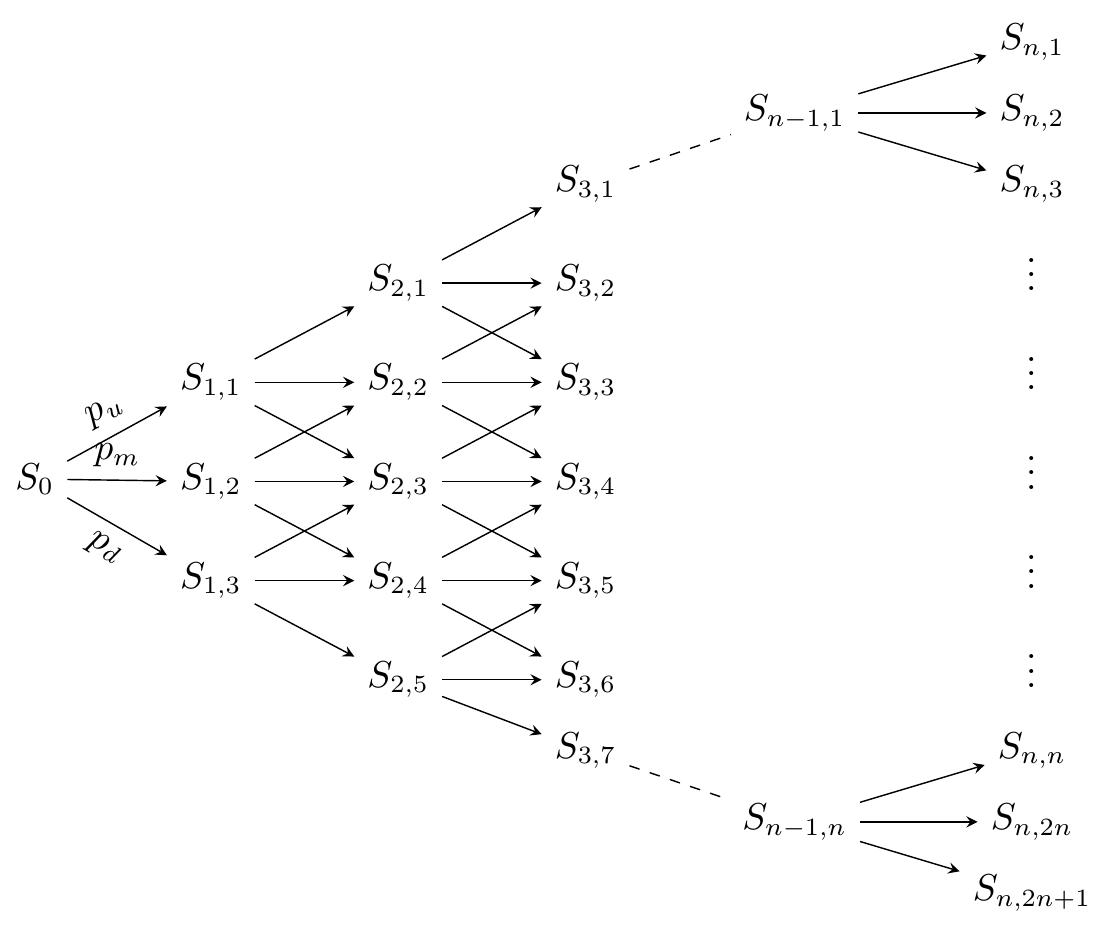
Construct binomial and trinomial trees with risk-neutral transition probabilities.
Price European and American options by backward induction.
Estimate Delta and Gamma using standard and extended trees.
Explain odd/even step effects and improve convergence with smoothing and extrapolation.
Methods: Cox–Ross–Rubinstein, flexible binomial trees, binomial Black–Scholes trees, Boyle trinomial trees and Richardson extrapolation.
Three branches; recombining nodes.
Chapter 03 · Coming soon
Monte Carlo Simulation
Simulation-based pricing, variance reduction and estimators for sensitivities.
Simulate price paths under geometric Brownian motion, Merton, VG and NIG models.
Generate correlated assets and price European, spread, basket and Asian options.
Measure sampling error and reduce variance; compare ordinary and randomized quasi-Monte Carlo.
Compare Greek estimators and price American options through least-squares regression.
Tools: Cholesky factorisation, control variates, importance sampling, scrambled Sobol sequences and pathwise and likelihood-ratio Greeks.
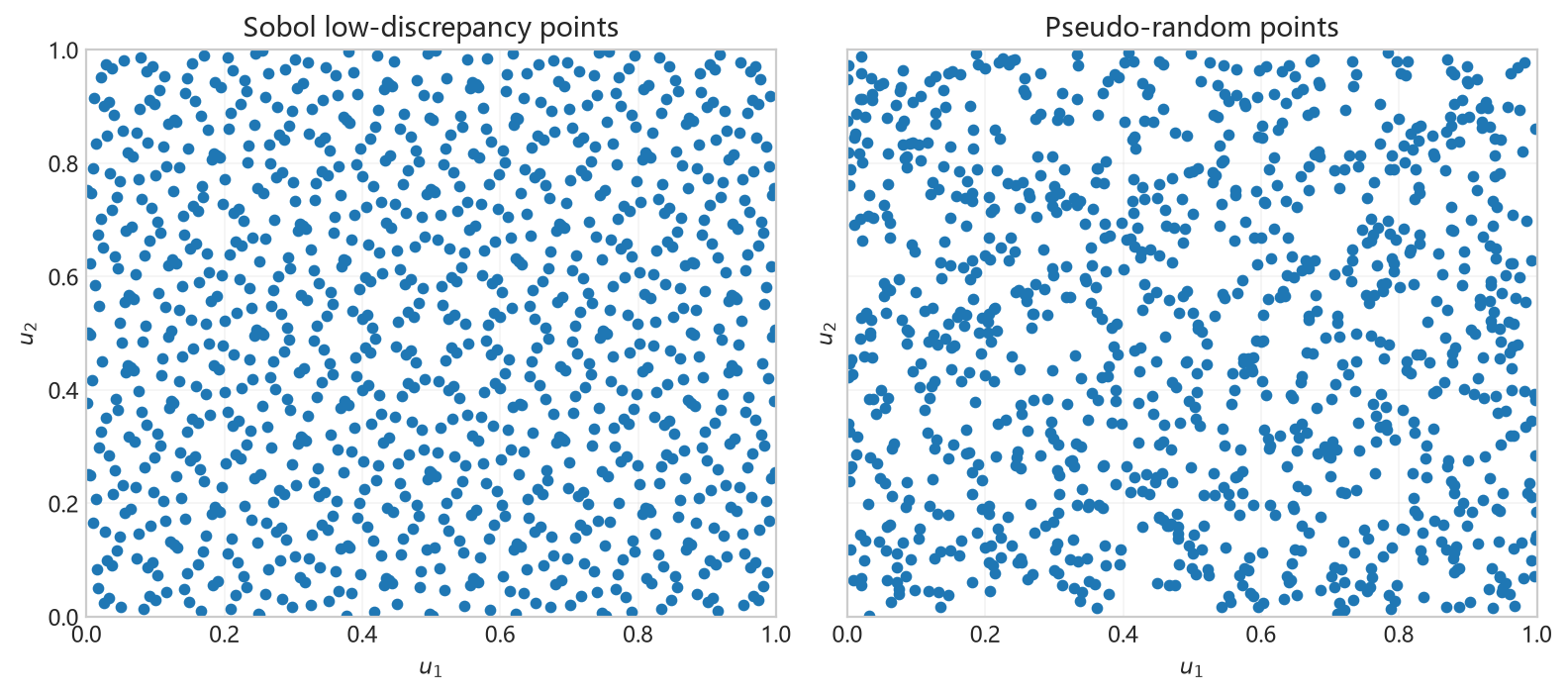
1,024 points: Sobol (left), pseudorandom (right).
Chapter 04 · Coming soon
Partial Differential Equations
Grid-based pricing through finite-difference approximations to the Black–Scholes PDE.
Derive the pricing equation and transform it into the heat equation.
Set a finite grid, initial conditions and boundary values.
Compare time-stepping schemes, stability, price errors and Greeks.
Enforce American exercise constraints and locate the exercise boundary.
Methods: Explicit and implicit Euler, Crank–Nicolson, tridiagonal systems, successive over-relaxation and projected iteration.
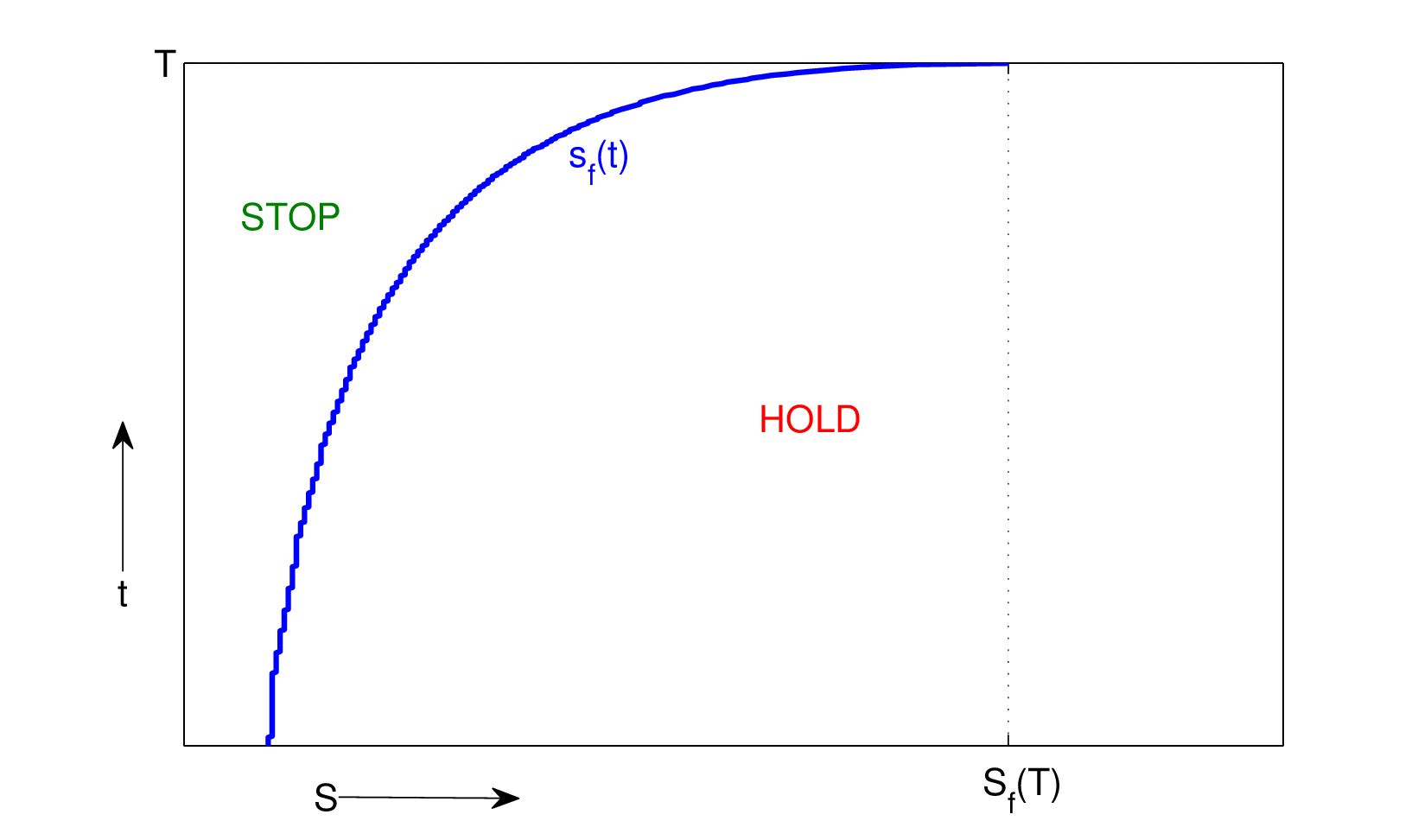
The boundary between exercise and continuation.
Chapter 05 · Coming soon
Saddlepoint Approximation
Distribution and tail-probability approximations built from cumulant-generating functions.
Construct generating functions and solve the saddlepoint equation.
Approximate densities and tail probabilities for continuous and discrete distributions.
Express option values through tail probabilities and changes of measure.
Apply pricing approximations to Merton, VG and NIG models; compare with exact results and Monte Carlo.
Methods: Daniels density correction, Lugannani–Rice tails, Rogers–Zane pricing and Carr–Madan saddlepoint pricing.
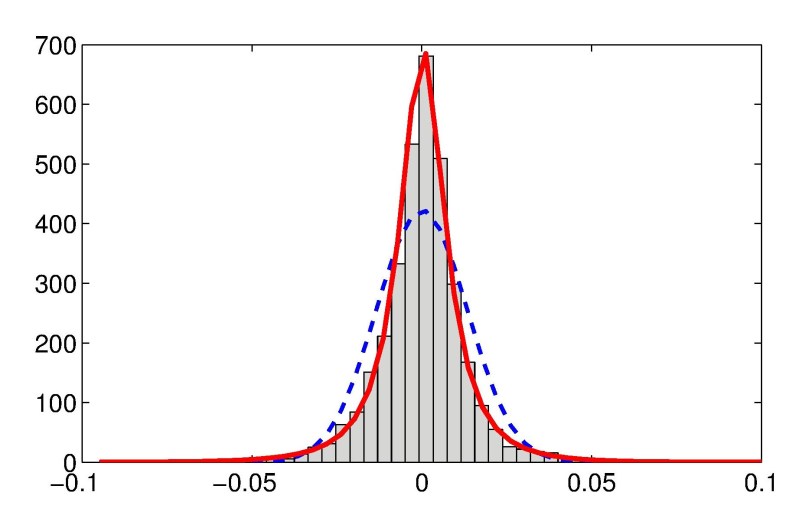
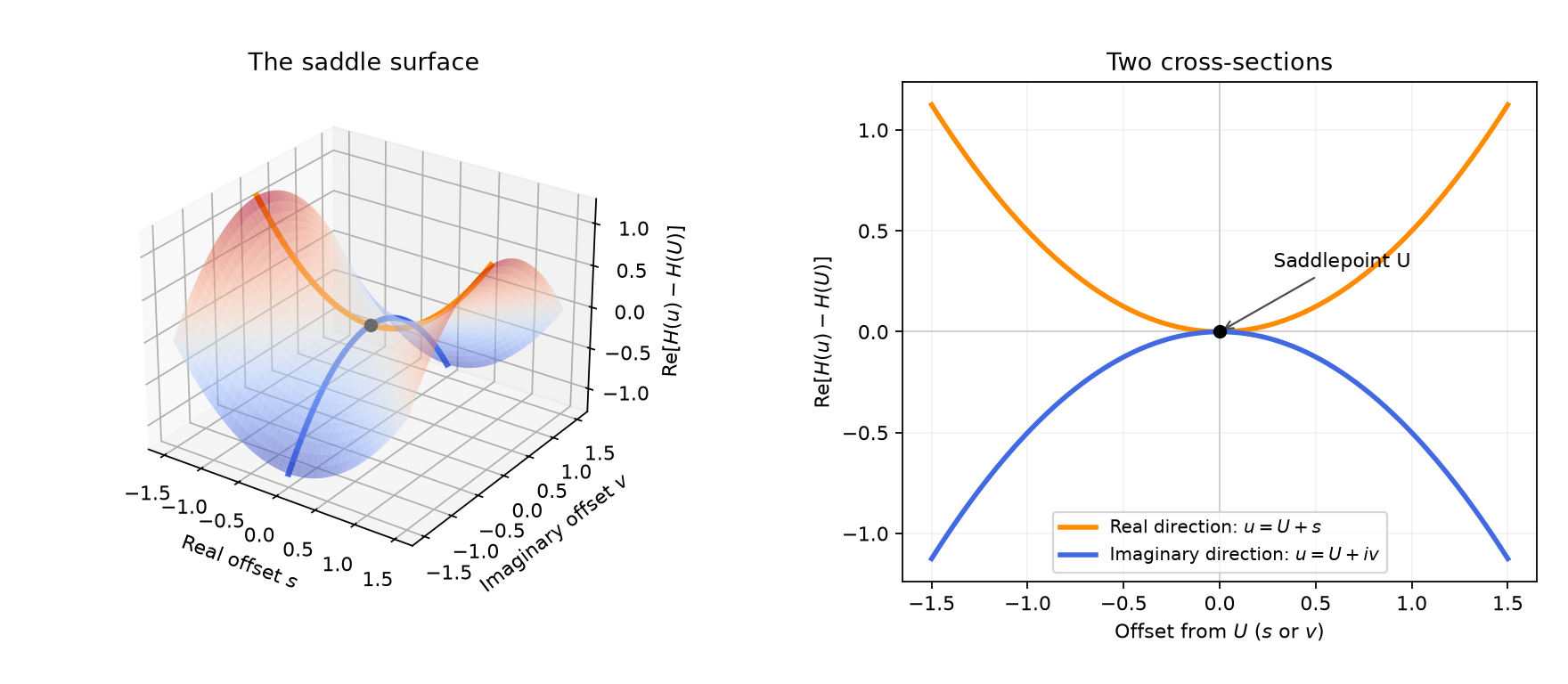
The exponent near its saddlepoint.
Chapter 06 · Coming soon
Fourier-Based Methods
Characteristic-function methods for fast pricing and controlled numerical error.
Build characteristic functions for Black–Scholes, Merton, VG and NIG models.
Recover densities and price European options with three Fourier methods.
Choose damping, frequency spacing, cutoffs and expansion terms.
Price Bermudan and American options by backward induction and extrapolation; compute Greeks across strikes.
Methods: Carr–Madan FFT, convolution (CONV) and Fourier–cosine (COS) expansion, with truncation, discretisation and periodicity errors.
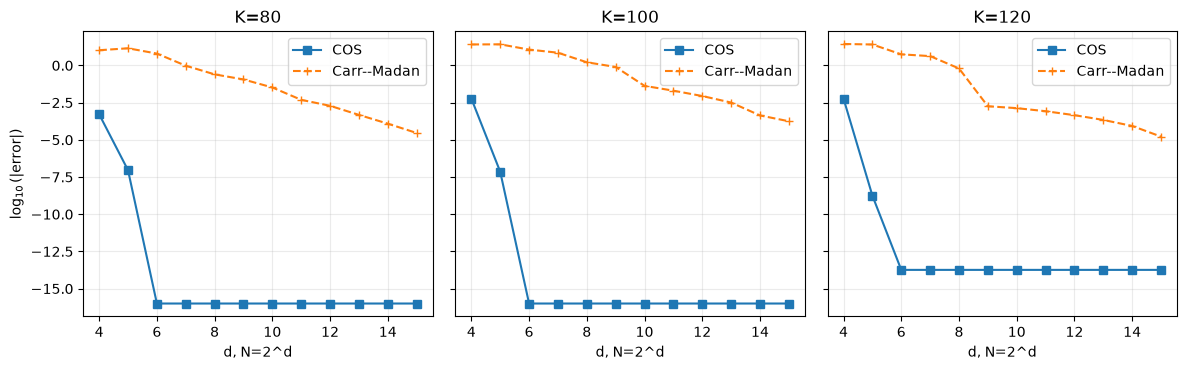
COS and Carr–Madan pricing-error convergence (K = 80).
Experiments you can run
Change a setting. Inspect the result.
01 · Tree steps
Compare prices from odd and even step counts and measure convergence.
02 · Simulation paths
Measure sampling error and the gain from variance reduction.
03 · PDE grids
Refine space and time and locate unstable settings.
04 · Fourier settings
Vary damping and frequency spacing and compare accuracy across strikes.
Python toolkit: NumPy, SciPy, pandas, Matplotlib and Jupyter.
FAQ
What knowledge do I need?
Basic probability, calculus and Python. The book connects the mathematical steps with their numerical implementation.
What can I read online now?
The introduction and Chapters 1–2 are free to read online. The remaining chapters are coming soon.
Does it cover early exercise?
Yes. Tree methods, least-squares Monte Carlo, PDE exercise constraints and Fourier backward induction cover American or Bermudan pricing.
How do I assess numerical accuracy?
Compare with benchmarks, measure Monte Carlo sampling error, and vary tree steps, PDE grids and Fourier settings to examine convergence and stability.
Can I download the notebooks?
Chapter 1 is free after registration. A one-time purchase of €19.99 includes the complete six-chapter notebook collection in English and Chinese, with supporting files and all remaining chapters as they are released.
How do I download Chapter 1?
Chapter 1 is free to download after registration. Sign in to choose the English or Chinese package.